AI that does company work, and answers to the company.
Anyam is a Company AI Operating System. Your work is written down once as a visible, versioned Flow. AI, tools and people each take the steps they are allowed to take, a person approves what matters, and every result is kept on the record. theLabs installs it on a server that belongs to your company and builds the first Flow with you.
implemented with you · one dedicated server per company · your own model accounts
Anyam is not self-serve. There is no public demo, no free tier and no price list: scope and price are agreed per engagement, because no generic number would be true. Each company runs alone on its own server; this release does not pool companies or span several machines. Two parts of the product are unfinished and are named in the questions below rather than discovered later.
The problem
A chat window is not a system of record.
Most company AI today is a transcript. Nobody can say afterwards which version of the process ran, what the model was allowed to touch, who approved the message that went out, or what to do when a tool call may or may not have gone through. The work got done, or it did not, and the evidence is a scrollback.
What it looks like
Four screens from the demo workspace. The same things the page claims, as the people running them see them.
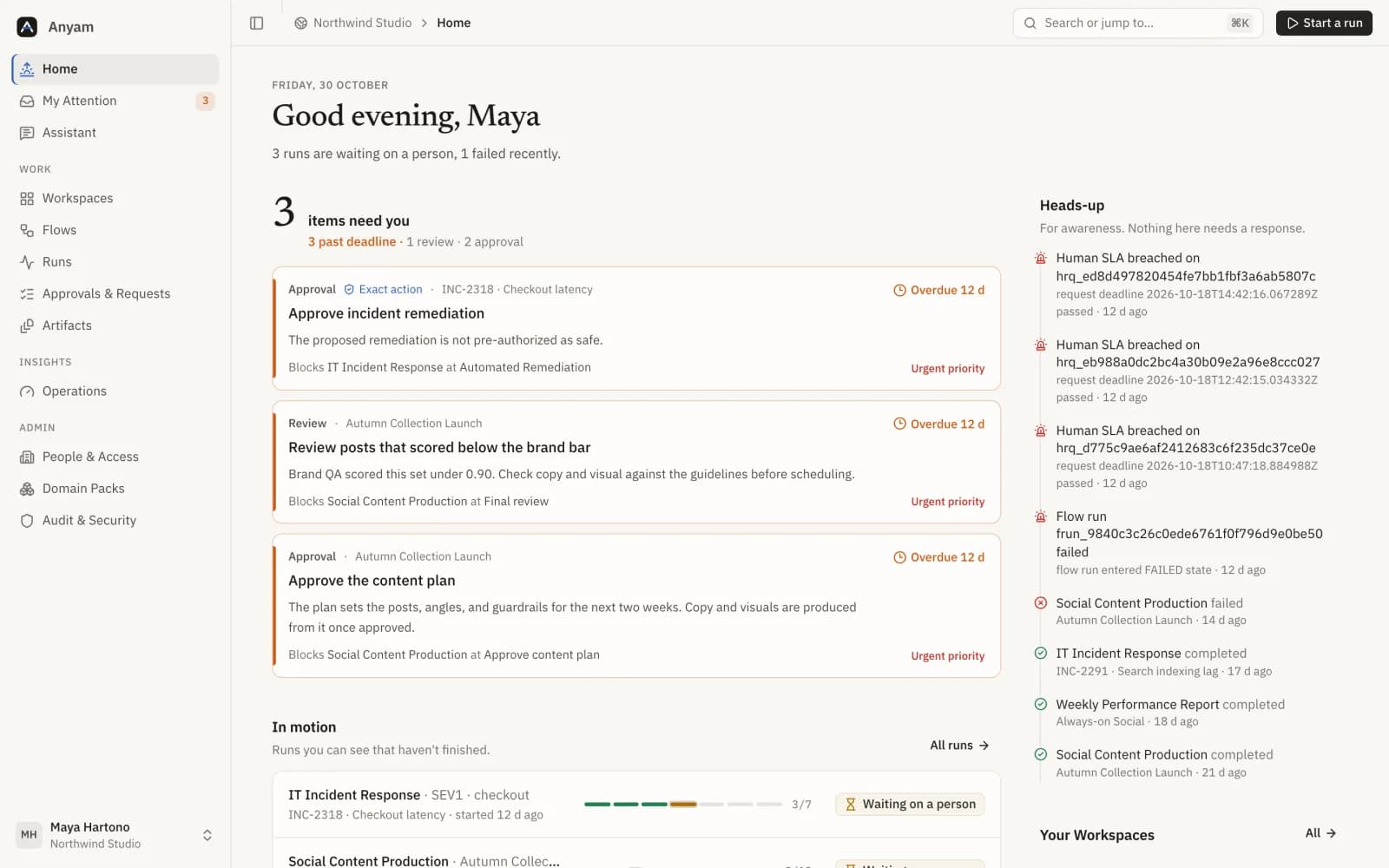
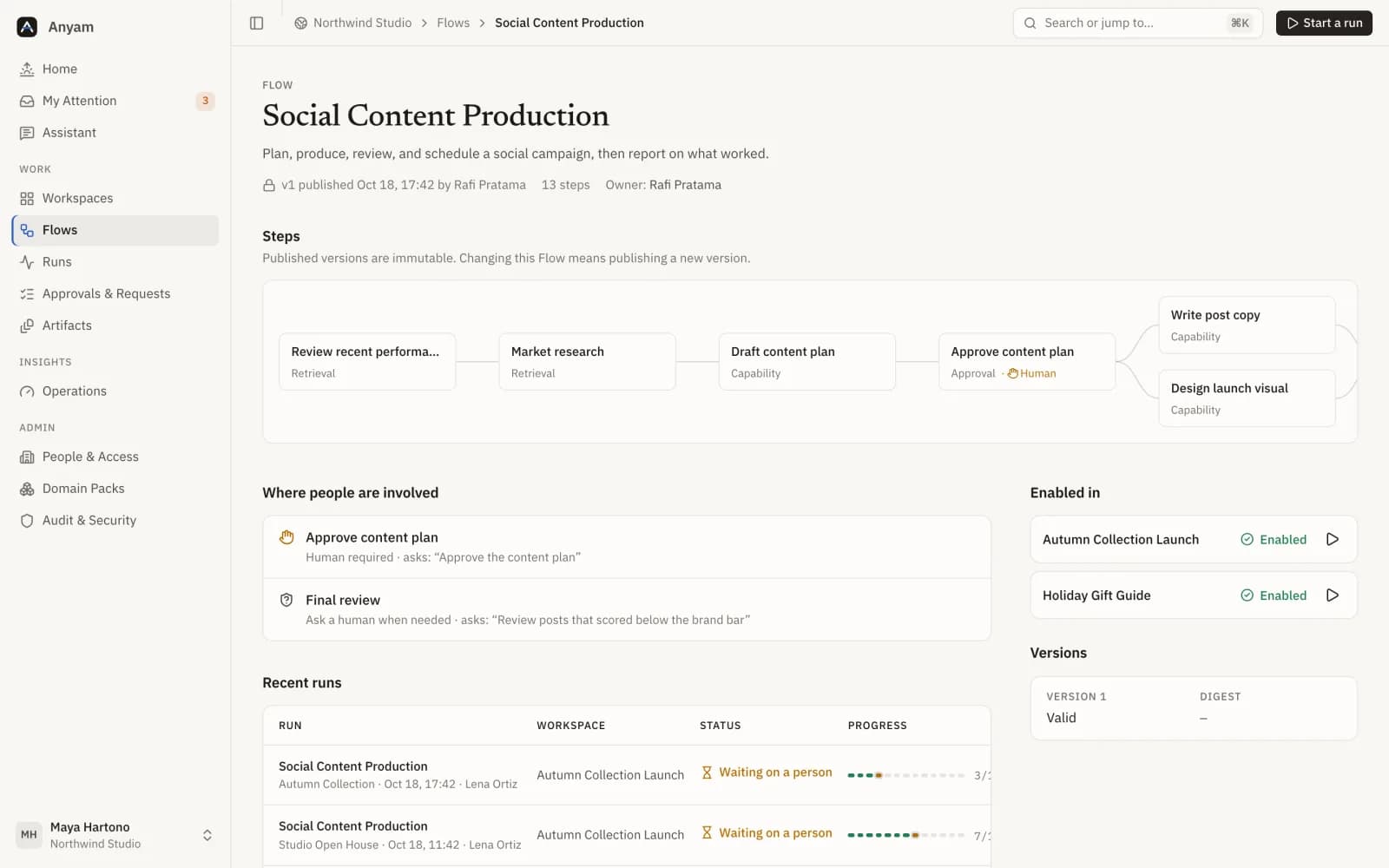
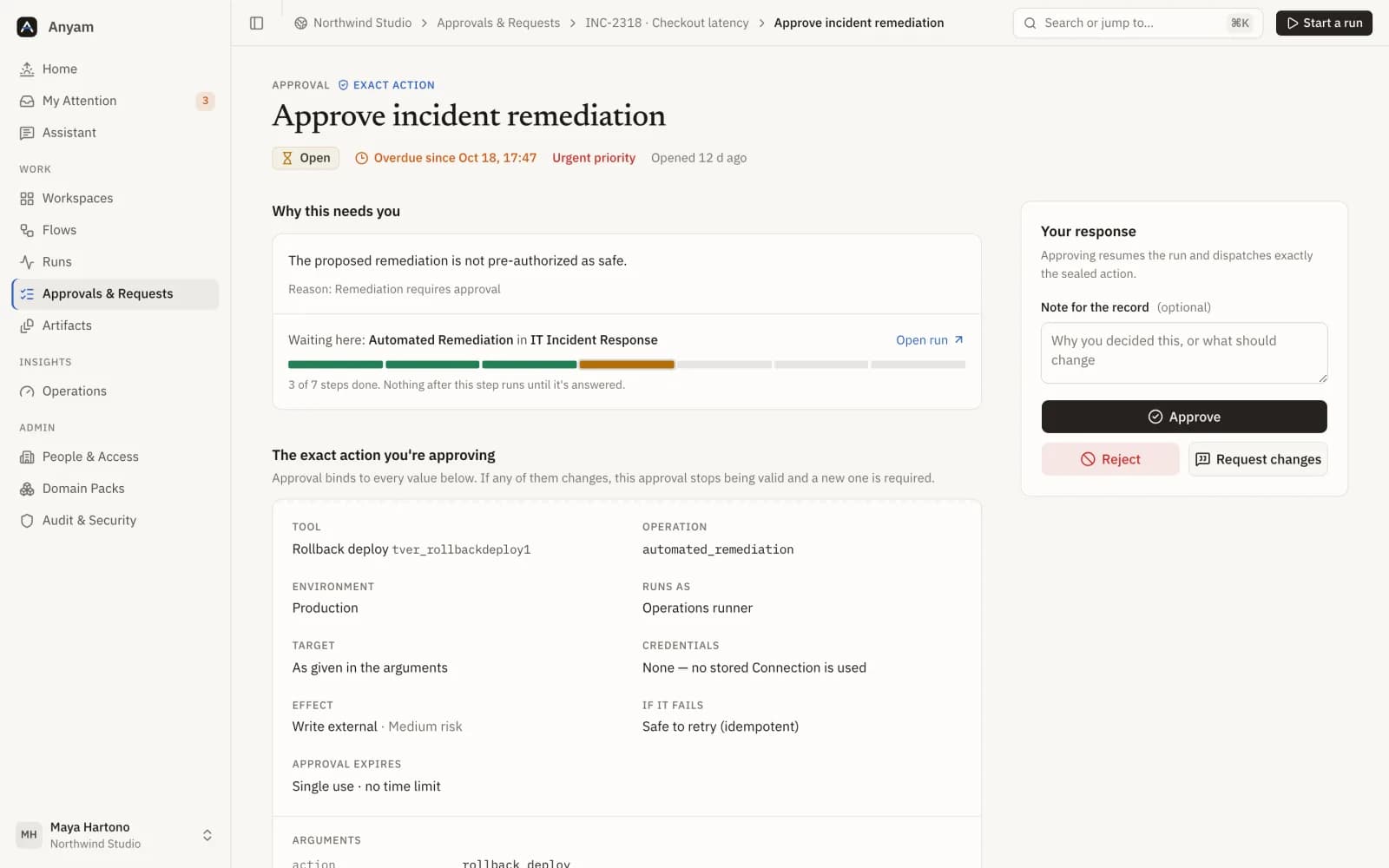
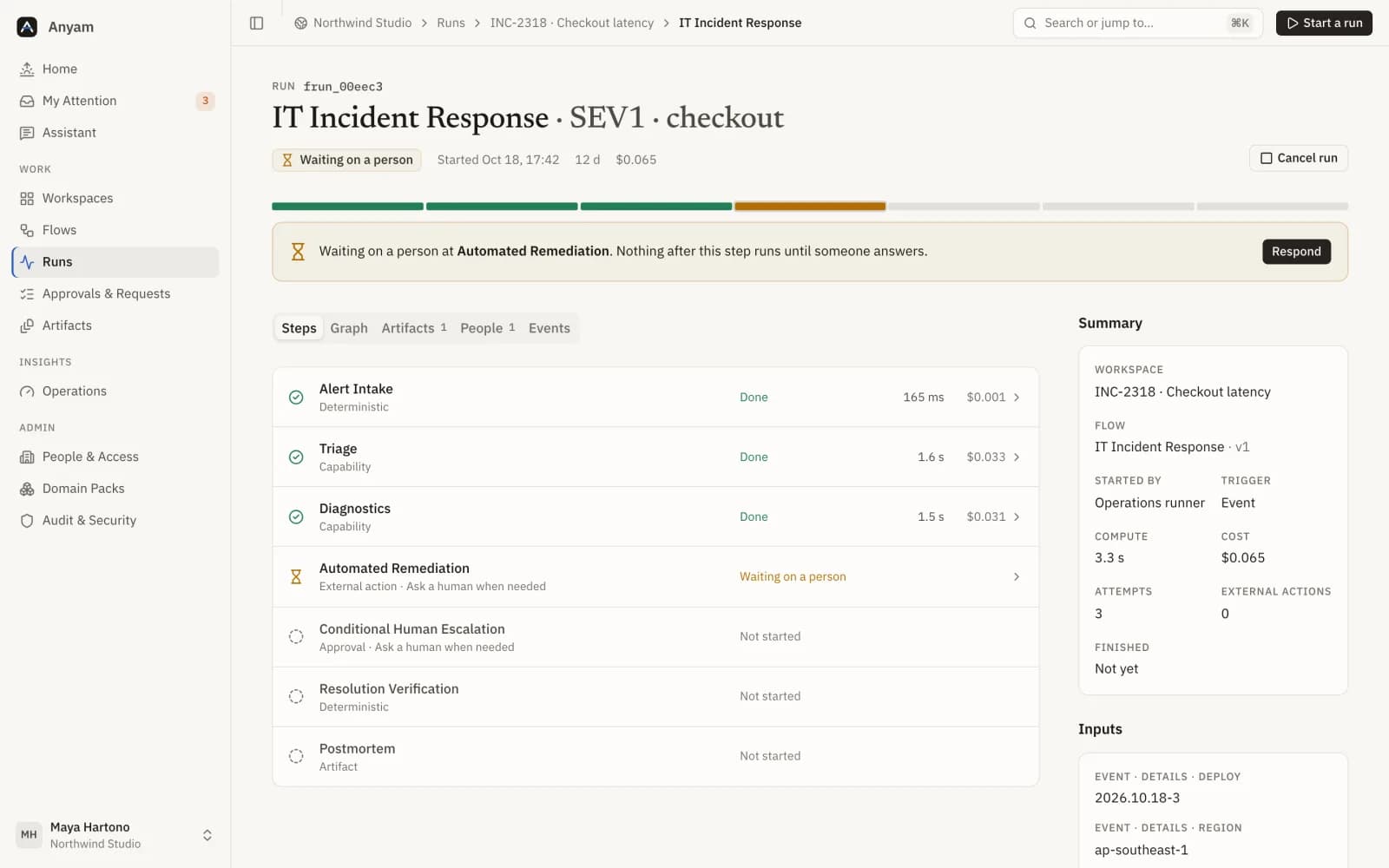
Captured from a local Anyam stack on 30 October 2026, signed in to the demo organization that ships with it. Northwind Studio, its people, runs and figures are seed data, not a customer.
Work is defined once, run many times, and kept.
Seven words carry the whole product. Everything else exists to serve them.
- Workspace
- A boundary around one piece of your business: a project, an ongoing operation, a case. Who may see and do what is decided here, before any AI runs.
- Workspace Brain
- What that Workspace knows: facts, decisions, knowledge and references, kept as reviewed revisions rather than remembered by a model.
- Flow
- The process, written down as steps and the edges between them, versioned and published. Anyone with access can read it. Replacing every model underneath leaves it unchanged.
- Run
- One execution of a Flow. Durable: a server restart, a lost worker or a slow provider resumes where it left off instead of starting again.
- Capability
- Each step asks for what is needed, such as research or copy, not for a named bot. An agent, a model, a tool, a service or a person fulfils it, and can be swapped.
- Human
- People take part by policy. A step can run on its own, ask only when something is off, or always wait for a person.
- Artifact, Action, Decision
- The results. Versioned documents with lineage, external actions with settlement evidence, and decisions with who made them and why.
Oversight
People stay in charge by policy, not by luck.
Every Flow and every step declares how much a person is involved. The policy decides, not the model's mood and not an operator's memory.
- AutonomousRuns without a person. For steps whose worst outcome is a draft nobody has to read.
- ConditionalAsks for a person only when a check fails or a rule says so. Otherwise it keeps going.
- Human requiredAlways waits. For anything that leaves the company or cannot be undone, the person sees the exact action before it fires.
An approval is for one exact action, sealed before anyone looks at it. Change the recipient, the amount or the text after approval and the action is refused, not quietly re-sent. Approvals are used once, and they expire.
What the system will not do
Boundaries written into the specification and enforced in code, not in a policy document.
- No model holds a credential, a budget or a permission. Keys live in your deployment's secret store and are used by the gateway on the model's behalf, under your policy.
- No blind retry after an uncertain external effect. If a payment, a post or an email may have gone through, the run stops and a person records what actually happened.
- No business state that lives only in a prompt, a chat history or a worker's memory. If it matters, it is a versioned record.
- No agent org chart as the process. Agents are providers of capabilities; the Flow is the contract.
- Every write is audited and attributed. The audit trail is append-only and is written in the same transaction as the change it describes.
- Authorization before retrieval. A step cannot read what its Workspace membership does not allow, so a model never sees the wrong client's knowledge.
Your company, your server, your keys.
Anyam ships as a hardened container stack for one company at a time.
- One server per company
- A dedicated Linux server, your own database, secrets and HTTPS hostname. No other company's data shares the machine.
- Backups you hold
- Encrypted backups to storage you own, with a rehearsed restore, so the runbook is a procedure rather than a promise.
- Your sign-in
- Your identity provider through OpenID Connect, or local accounts under your policy. Sessions and invitations are administered inside the product.
- Your model accounts
- Model and tool credentials are yours, stored on your server and never inside a Flow. Switching provider changes a connection, not the process.
- Starting points, not lock-in
- Domain Packs seed Flows, schemas and policies. The first is marketing and creative production: social content from brief to approved post. The second, IT incident handling from alert to postmortem, proved the same core fits a different kind of work.
What an implementation looks like
Four steps, each with something you can check at the end of it.
A conversation about the work.
Which process goes first, who has to approve what, and which systems it touches. If AI is the wrong tool for it, we say so here.
Your server, set up.
A dedicated server with HTTPS, backups, monitoring and your sign-in, built from pinned images by the written runbook.
The first Flow, built with you.
Your Workspace, your knowledge, your approval gates and your connections, run end to end until a person approves a real result.
Handover.
Your administrators hold the keys and the runbook. theLabs stays reachable, but nothing about the deployment depends on us being there.
Scope and price are agreed per engagement. None is published here because no generic figure would be true for your company.
Questions a skeptic would ask
- Is this a chatbot?
- No. Anyam has an assistant, but it is a safe way into governed work, not the work itself. The process lives in Flows anyone with access can read; the assistant can start, inspect and answer about them within what you are allowed to see.
- Does the AI get our passwords?
- No. Credentials sit in the secret store on your server and are used by the tool gateway, which checks your policy before every call. A model proposes an action; it never holds the key that performs it.
- Which models does it use?
- The ones you choose. Flows ask for capabilities, not vendors, so a step can run on a hosted model, a local one or a person, and be moved later without touching the Flow. The accounts and keys are your own.
- Can our team run it without theLabs?
- Yes. It is your server, your database and your administrator accounts, with a written runbook for upgrades, backup and restore. The engagement ends with a handover, not a subscription you cannot leave.
- Is it open source?
- No. The source is private. What you receive is a deployment you fully control, with its contracts, runbook and audit trail readable by your own people.
- Is it finished?
- The core, the API, the worker and the web application are built and under test on three database backends. Two surfaces are not done and are stated here rather than discovered later: there is no separate client-portal interface yet, and the library interface for reusable agents is still in progress.
- What does it cost?
- It depends on the work, so it is agreed per engagement. There is no public price list because a single number would be wrong for most companies.
Tell us the work you want governed.
One message is enough to start: what you would hand to AI first, and who has to approve it. The person who reads it is the one who built Anyam.
Prefer plain email? [email protected] · Or use the contact page